Le Infezioni in Medicina, n. 3, 361-365, 2026
CASE REPORTS
Ceftazidime-avibactam in elastomeric pump for vascular graft infection: a case report
Marco Berruti1, Rachele Pincino1, Davide Laurenda1, Katiusha Sciolè1, Manuela Migliorati1, Nicola Forni1, Gemma Malerba1, Sara Tita Farinella1, Laura Casella2, Giovanni Cenderello1
1Infectious Diseases Unit, Azienda Tutela Salute Liguria, Area 1, Sanremo, Italy;
2Pharmacy Unit, Azienda Tutela Salute Liguria, Area 1, Sanremo, Italy.
Article received 13 April 2026 and accepted 02 July 2026
Corresponding author
Marco Berruti
E-mail: m.berruti@asl1.liguria.it
SUMMARY
Introduction: Vascular prosthetic infections (VPI) are associated with high morbidity and mortality, often requiring prolonged antimicrobial therapy. The emergence of carbapenem-resistant Enterobacterales (CRE) represents a significant challenge due to the limited availability of outpatient treatment options. While ceftazidime-avibactam is a cornerstone of the treatment of CRE infections, its 12-hour stability limit poses a barrier for standard Outpatient Parenteral Antimicrobial Therapy (OPAT).
Case presentation: We describe a 78-year-old male with multiple comorbidities (diabetes, peripheral artery disease, and ischemic cardiomyopathy) who presented with a VPI following an axillo-femoral bypass. Initial cultures isolated MRSA and ESBL-producing Klebsiella pneumoniae. Despite surgical debridement and various antibiotic regimens, the patient experienced a recurrence with inguinal fistulization. A subsequent isolate of K. pneumoniae demonstrated resistance to both ertapenem and ceftolozane-tazobactam.
Treatment was transitioned to daptomycin (500 mg daily) and ceftazidime-avibactam (2.5 g three times a day), with oral rifampin added for anti-biofilm activity. To facilitate early discharge per the patient’s request, ceftazidime-avibactam was administered off-label via an elastomeric pump. A continuous infusion regimen of 5 g every 12 hours was delivered through a PICC line. This schedule addressed the drug’s stability constraints while requiring only two daily administrative interventions.
The patient completed the OPAT course without adverse events or signs of pyridine-related toxicity. Clinical and microbiological resolution was achieved, and no relapses were detected during the follow-up period.
Conclusions: This case demonstrates that continuous 12-hour infusion of ceftazidime-avibactam via elastomeric pumps is a feasible and safe strategy for managing complex CRE infections in the OPAT setting. Such tailored approaches can enhance patient quality of life and reduce hospital stays, though further prospective studies are needed.
Keywords: Vascular Prostethic infection, Carbapenemases-producing Klebsiella pneumoniae, Outpatient Parenteral Antimicrobial Therapy.
INTRODUCTION
Vascular prosthetic infections represent a challenge in clinical practice due to their high morbidity and mortality rates, necessitating in most cases both surgery and prolonged antimicrobial therapy [1]. Gram-negatives Enterobacterales (GNE) are responsible for a non-negligible proportion of these cases and carbapenem-resistant (CR) GNE represent a significant challenge in this setting due to limited treatment options only approved for intravenous in-hospital administration [2]. The use of elastomeric pumps for outpatient parenteral antimicrobial therapy (OPAT) as an alternative to in-hospital intravenous treatment emerged as a promising solution for managing complex infections such as endocarditis or osteomyelitis, thereby enhancing patient quality of life and potentially reducing complication risks [3, 4]. The use of these devices allows consistent drug levels and improved therapeutic efficacy even in the outpatient setting [5, 6]. Recently Ferreiro et al. demonstrated not only effectiveness and safety but also the potential economic benefit of the administration through an elastomeric pump of piperacillin-tazobactam in OPAT compared to conventional inpatient treatment in severe infections, including those caused by Pseudomonas aeruginosa [7]. Ceftazidime-avibactam is a pivotal drug for treating infections caused by CR-GNE but, according to the current approved labelling it is not stable for a period longer than 12 hours. This limitation represents a significant barrier for its use in OPAT regimens, where 24 hours stability is often necessary for both OPAT services working schedules and patient compliance [7, 8]. This case report aims to describe the successful management of a vascular prosthetic infection caused by a carbapenem-resistant Klebsiella pneumoniae using ceftazidime-avibactam administered via an elastomeric pump in an outpatient setting.
CLINICAL CASE
A 78-year-old male patient allergic to penicillin with a history of diabetes mellitus, peripheral artery disease, chronic obstructive pulmonary disease and ischemic cardiomyopathy underwent axillo-femoral-bypass in July 2023 per peripheral artery disease in another hospital and was readmitted in October of the same year showing signs of infection. The patient was treated with broad-spectrum antibiotics and surgical debridement and distal graft substitution with isolation of Enterococcus faecium, Staphylococcus aureus methicillin-resistant (MRSA) and an extended-spectrum β-lactamase (ESBL)-producing Klebsiella pneumoniae isolate.
The patient was discharged but was again hospitalized in February 2024 when he showed new local signs of infection with right inguinal fistulization. On February 2nd he underwent surgical debridement without graft removal and antimicrobial therapy including cefepime and linezolid followed by ertapenem and linezolid after isolation of MRSA and K. pneumoniae ESBL-producer in surgical samples. On February 17th the linezolid and ertapenem were substituted with daptomycin 500 mg daily and ceftazidime-avibactam 2.5 g three times a day due to cytopenia induced by linezolid and wound purulent discharge with isolation from a wound swab of an ESBL-producing K. pneumoniae strain resistant to ertapenem and ceftolozane-tazobactam. On March 3rd anti-biofilm therapy with oral rifampin 600 mg daily was also added.
On March 12th the patient improved and was transferred near his house to our Infectious Diseases department at Borea Hospital (Sanremo, Liguria, Italy) with the indication of continuing the current therapy.
Due to patient request for early discharge, from March 19th ceftazidime-avibactam was administered through elastomeric pump at the dosage of 5 g every 12 hours using a PICC central venous catheter. Off-label request was approved by the drug regulatory commission of the hospital and informed consent was signed by the patient. The OPAT approach implemented for our patient consisted of a Day Hospital–based program, supported by the inpatient service for elastomeric pump replacement during late evening hours and throughout weekends. During the treatment period, markers of inflammation and kidney and liver function were monitored twice a week.
On April 2nd the patient was discharged home and continued in Day Hospital the treatment with daptomycin, ceftazidime-avibactam and rifampin until May 10th with resolution of signs of infection and without adverse events. No evidence of clinical or microbiological relapse was detected during the follow-up. The post-treatment follow-up period lasted six months and included monthly clinical evaluations and assessment of inflammatory markers (Figure 1).
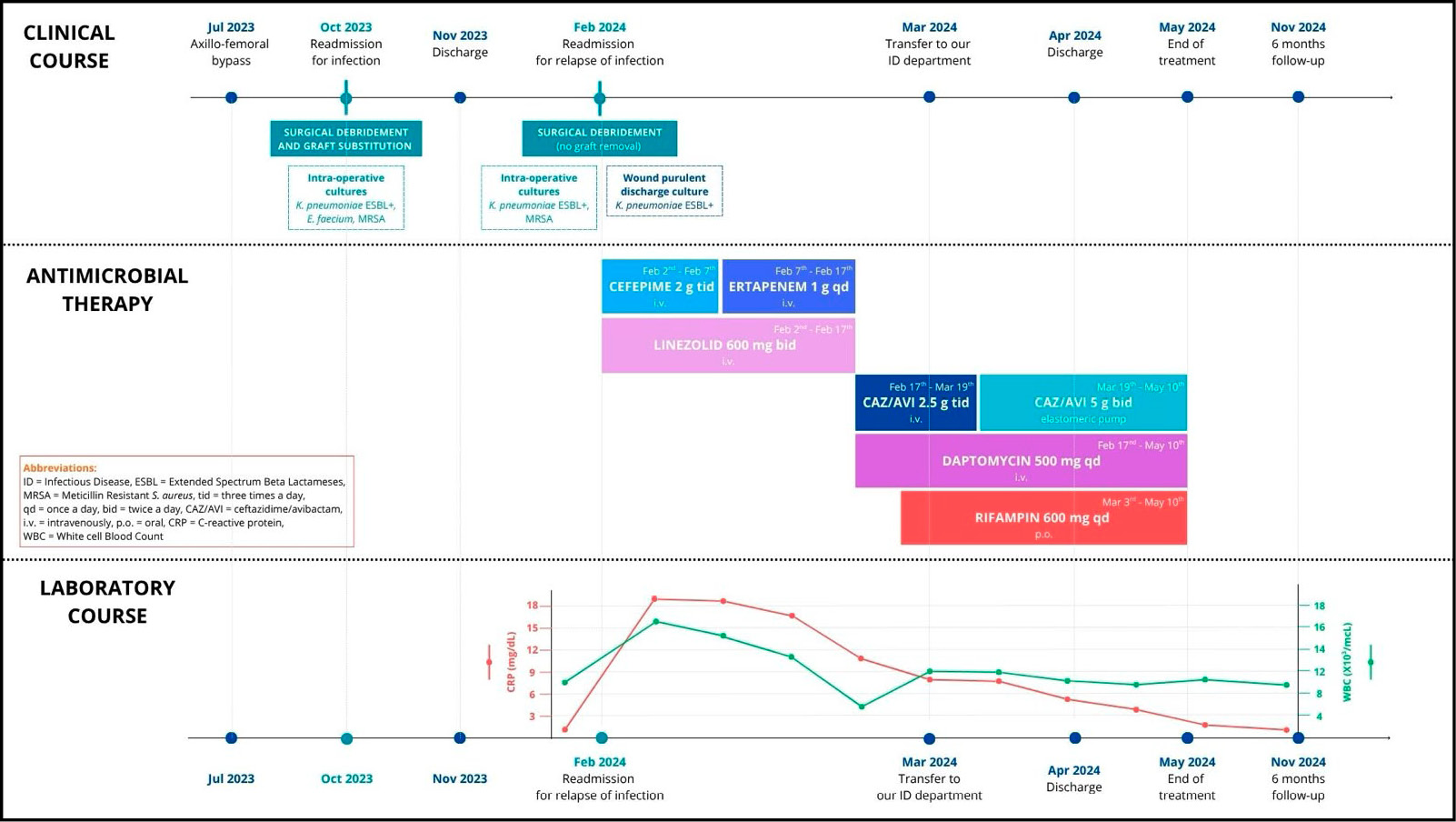
Figure 1 - Clinical case timeline.
DISCUSSION
Ceftazidime-avibactam was approved by European and Italian Drug Agencies for intravenous treatment of infection caused by difficult-to-treat Gram-negative bacteria at the dosage of 2.5 g three times a day in extended 3-hours infusion. This schedule is not sustainable by most OPAT services due to the necessity of multiple home accesses, but several recent papers have progressively addressed this issue.
Recent OPAT experiences have progressively supported the use of ceftazidime-avibactam administered by continuous infusion through elastomeric devices. Torres-Del-Pliego et al. first described successful home administration, while Goncette et al. demonstrated that a regimen of 5 g every 12 hours achieved adequate PK/PD exposure and therapeutic concentrations in most patients [9, 10]. More recently, Merad et al. reported prolonged outpatient administration in complex bone and joint infections [1]. These experiences suggest that a 12-hour infusion schedule may represent a practical strategy to balance antimicrobial exposure, stability constraints and OPAT feasibility. Furthermore, these clinical issues are well supported by stability data, in fact Naicker et al. showed that ceftazidime-avibactam may be acceptable to administer as a 12-hour infusion observing a degradation <10% [11]. Of note, a further element of concern in the use of continuous infusion of ceftazidime-avibactam in elastomeric pump could be accumulation of degradation products especially pyridine but pyridine-related toxicity has not been documented over previously cited clinical utilization [1, 9-12]. The pyridine exposure limit has been established at 100 mg limit but according to Naicker et al. even at the highest dose tested (6000 mg in 240 ml) the maximum amount was 76.9 mg in the EASYpump device and 60.2 mg in the Dosi Fuser device [11].
More recently Erdmann and Coll confirmed that a 12-hour infusion could represent an option in order to achieve efficacious drug concentration, limiting toxicity and managing patient in a home care setting [13]. Stability assessments of ceftazidime-avibactam for OPAT are influenced by the regulatory criteria applied. The study by Naicker et al. demonstrated that ceftazidime-avibactam did not meet the stringent UK NHS Yellow Cover Document (YCD) requirements for prolonged storage and administration, although the preparation may be considered acceptable under less restrictive criteria adopted in other European settings [11]. In light of these data, we adopted a 12-hour administration schedule to ensure drug stability throughout infusion.
The selection of a PICC was not solely based on logistical considerations but was largely guided by pharmacological factors, such as solution osmolarity, pH, the duration of infusion therapy and the need to reduce venous toxicity and phlebitis risk (Table 1). Of note the choice of PICC access over peripheral intravenous access was also due to vescicant and pharmacological properties of daptomycin. This approach is in line with the findings reported by Borgonovo [14].
The lack of therapeutic drug monitoring (for logistical reasons) for ceftazidime-avibactam represents the main limitation of our report as individual PK/PD target attainment could not be confirmed. Moreover, no pyridine-related toxicity was observed in our patient, but this finding cannot rule out a population-level risk. So additional pharmacovigilance data and prospective studies are warranted.
In light of these considerations, our therapeutic strategy should be viewed as a pragmatic and evidence-based clinical approach, grounded in available pharmacological and clinical data rather than a purely anecdotal decision.
Table 1 - Physicochemical characteristics of ceftazidime-avibactam and daptomycin (modified by Borgonovo et al.).

CONCLUSIONS
Our clinical case highlights the possibility of treating a difficult-to-treat infection with a continuous infusion of ceftazidime-avibactam 5 g every 12 hours although we encountered multiple difficulties including the site of infection, presence of prosthetic material and the twice-a-day hours schedule of administration. This approach is now sustained by several pharmacological and clinical data and should be taken into consideration in selected cases when a tailored approach is required but must be noted that more detailed prospective studies are needed .
Conflict of interest
The authors declare no conflicts of interest.
Funding
No direct or indirect funding was received for this work.
REFERENCES
[1] Merad Y, Conrad A, Brosset S et al. Case report: Continuous infusions of ceftazidime-avibactam and aztreonam in combination through elastomeric infusors for 12 weeks for the treatment of bone and joint infections due to metallo-β-lactamase producing Enterobacterales. Front Med. 2023; 10: 1224922.
[2] Shah J. and Feinfeld DA. Use of ‘Locked-In’ Antibiotic to Treat an Unusual Gram-Negative Hemodialysis Catheter Infection. Nephron. 2000; 85(4): 348-350.
[3] Venuti F, Gaviraghi A, De Nicolò A et al. Real-Life Experience of Continuously Infused Ceftolozane/Tazobactam in Patients with Bronchiectasis and Multidrug-Resistant Pseudomonas aeruginosa Infection in the Outpatient Setting. Antibiotics. 2023; 12(7): 1214.
[4] Rodríguez-Martínez L, Castro-Balado A, Hermelo-Vidal G, et al. Ampicillin Stability in a Portable Elastomeric Infusion Pump: A Step Forward in Outpatient Parenteral Antimicrobial Therapy. Pharmaceutics.2023; 15(8): 2099
[5] Voumard R, Gardiol C, André P et al. Efficacy and safety of continuous infusions with elastomeric pumps for outpatient parenteral antimicrobial therapy (OPAT): an observational study. J Antimicrob Chemother. 2018; 73(9): 2540.
[6] Fernández-Rubio B, Del Valle-Moreno P, Herrera-Hidalgo L et al. Stability of Antimicrobials in Elastomeric Pumps: A Systematic Review. Antibiotics. 2021; 11(1): 45.
[7] Ferreiro JLL, Otero JÁ, Rivo AS et al. Outpatient therapy with piperacillin/tazobactam using elastomeric pumps in patients with Pseudomonas aeruginosa infection. Sci Rep. 2021; 11(1): 8610.
[8] Alghoribi MF, Alqurashi M, Okdah L et al. “Successful treatment of infective endocarditis due to pandrug-resistant Klebsiella pneumoniae with ceftazidime-avibactam and aztreonam. Sci Rep. 2021; 11(1): 9684.
[9] Torres-Del-Pliego E, Delgado-Mejía E, Gil-Alonso L, Del Mar-Periáñez-Párraga L. First case of ceftazidime/avibactam administration in home care. ESBL producing Klebsiella pneumoniae bacteremia. Enferm Infecc Microbiol Clin. 2017; 35(5): 322-323.
[10] Goncette V, Layios N, Descy J, Frippiat F. Continuous infusion, therapeutic drug monitoring and outpatient parenteral antimicrobial therapy with ceftazidime/avibactam: a retrospective cohort study. J Glob Antimicrob Resist. 2021; 26: 15-19.
[11] Naicker S, Roberts JA, Won H, et al. Evaluation of the stability of ceftazidime/avibactam in elastomeric infusion devices used for outpatient parenteral antimicrobial therapy utilizing a national stability protocol framework. J Antimicrob Resist. 2024; 6(2): dlae056.
[12] Jones TE, Selby PR, Mellor CS, Cheam DB. Ceftazidime stability and pyridine toxicity during continuous i.v. infusion. Am J Health Syst Pharm 2019; 76: 200-205.
[13] Erdmann J, Vu LAT, Halbeisen D, Rentsch KM. Stability of Two Reserve Antibiotics in Elastomeric Pumps: Ceftazidime-Avibactam and Ceftolozane-Tazobactam. Antibiotics. 2025; 14(10): 966.
[14] Borgonovo F, Quici M, Gidaro A, et al. Physicochemical Characteristics of Antimicrobials and Practical Recommendations for Intravenous Administration: A Systematic Review. Antibiotics (Basel). 2023; 12(8): 1338.