Le Infezioni in Medicina, n. 3, 253-259, 2026
EDITORIAL
Beyond the rubble: Dengue, Chikungunya, and Vector-Borne Disease risks after 2026 Venezuela’s earthquake doublet
Alfonso J. Rodriguez-Morales1, Alejandro Risquez2, Juan-Carlos Navarro3
1Faculty of Health Sciences, Universidad Científica del Sur, Lima, Peru;
2Faculty of Medicine, Universidad Central de Venezuela, Caracas, Venezuela;
3Facultad de Veterinaria, Universidad Alfonso X El Sabio (UAX), Madrid, Spain.
Article received 20 July 2026 and accepted 09 August 2026
Corresponding author
Alfonso J. Rodriguez-Morales
E-mail: arodriguezmo@cientifica.edu.pe
The earthquake doublet that struck north-central Venezuela on 24 June 2026 has produced an emergency whose consequences extend well beyond trauma and displacement [1, 2]. The Capital District and the states of Aragua, Carabobo, Falcón, La Guaira, Miranda, and Yaracuy form a heterogeneous ecological and epidemiological corridor, encompassing densely populated coastal and metropolitan areas as well as peri-urban, rural, foothill, and forest-fringe communities. This diversity matters: a uniform post-earthquake infectious-disease response will overlook the distinct conditions that govern vector exposure, transmission, and access to early care [3-7].
Earthquakes do not directly cause vector-borne disease outbreaks, and the threat should not create avoidable alarm [8, 9]. They can, however, dismantle the barriers that limit transmission: reliable water supply, waste collection, vector-control operations, functional surveillance, clinical access, and public confidence in health services. During the rainy season, damaged homes, debris, discarded containers, interrupted water supply, household water storage, and temporary shelters may converge to increase risk. The task is not to predict an inevitable epidemic, but to prevent conditions that increase the likelihood of one [8, 10, 11]. As of 20 July 2026, publicly available post-earthquake information documented population displacement, temporary sheltering, infrastructure damage, and interruptions of essential services. However, no publicly reported entomological assessment had demonstrated an increase in Aedes abundance, and no increase in vector-borne disease transmission attributable to the earthquakes had been documented. Accordingly, the disease-specific risks discussed below are prospective and conditional, unless explicitly identified as documented observations.
Among the anticipated vector-borne risks, dengue warrants particular immediate attention in preparedness [3, 12, 13]. PAHO reported 1,366,831 suspected dengue cases in the Americas through epidemiological week 29 of 2026 (July 14, 2026) (388,878 confirmed cases) (https://www.paho.org/en/arbo-portal/dengue-data-and-analysis). However, this represented a decrease compared with both 2025 and the five-year average [14-17]. PAHO also identified dengue as one of the vector-borne diseases of concern following the Venezuelan earthquakes and emphasized the need for strengthened surveillance and outbreak prevention [14-17]. Although dengue transmission was established in Venezuela before the disaster, recent publicly accessible national and municipality-level surveillance data that would permit assessment of transmission intensity in the affected areas were unavailable [18]. Therefore, this prioritization reflects the combination of endemic transmission, urban Aedes ecology, the rainy season, and earthquake-related disruptions in water supply, waste management, and housing, rather than evidence of a post-earthquake increase in dengue incidence [19]. Debris, tires, plastic waste, damaged roofs, construction materials, and abandoned properties can further expand mosquito-breeding opportunities [3, 4, 10]. The emergency therefore requires attention beyond Caracas and La Guaira. Urban and peri-urban communities in Aragua, Carabobo, Falcón, Miranda, and Yaracuy may face similar disruptions but with differing vector densities, water systems, health service capacity, and mobility patterns.
Chikungunya should be considered alongside dengue [17]. It shares the same principal urban vectors and many operational determinants [20]. Acute fever, rash, myalgia, and arthralgia may be difficult to distinguish from dengue, Zika, or other febrile illnesses when laboratory capacity is overwhelmed [21, 22]. Yet chikungunya has distinctive implications: persistent joint symptoms can prolong disability, compromise recovery after injury, and impose an additional burden on displaced people, health workers, and responders [23]. Zika also remains relevant, especially for pregnant people and those of reproductive age, because its apparent clinical mildness must not obscure potential congenital consequences. Surveillance should thus detect acute febrile illness early while preserving access to confirmatory testing [24].
Clinical vigilance is especially important in shelters, emergency posts, and primary-care facilities. Patients with fever should be assessed for dehydration, bleeding, warning signs of severe dengue, pregnancy, extremes of age, comorbidities, and the feasibility of follow-up. Until dengue is reasonably excluded, aspirin and non-steroidal anti-inflammatory drugs should generally be avoided. Clear referral pathways, protected fluid stocks, basic hematology, and timely reassessment can prevent avoidable deaths even when access to advanced diagnostics is constrained [25].
The vector-borne landscape is broader than Aedes. Yellow fever deserves continued attention because Venezuela has recently faced renewed national transmission and epizootic activity [26,27]. The earthquake should not divert resources from vaccination, surveillance of non-human primate deaths, laboratory testing, and rapid investigation of suspected cases. Risk is particularly relevant for people moving between affected urban centers and rural, forested, or foothill areas, including responders engaged in recovery, transport, construction, and environmental work. Vaccination should follow national recommendations and individual risk assessment, with attention to people who have lost records or whose access to immunization has been interrupted [25].
Malaria is unlikely to be the foremost locally acquired threat in the most densely urban affected settings. Nevertheless, it must remain in the assessment of acute febrile illness. Population movement can connect the affected corridor with malaria-endemic areas, and disrupted care can delay diagnosis among patients with recent travel, migration, occupational, or environmental exposure. Rapid diagnostic testing, microscopy where feasible, and prompt treatment must remain available for compatible histories. A similar principle applies to Oropouche and Mayaro viruses: neither should be presumed to cause post-earthquake transmission [28], but both warrant diagnostic consideration when compatible syndromes and exposure histories are present, especially in communities connected to rural or forested environments [29, 30].
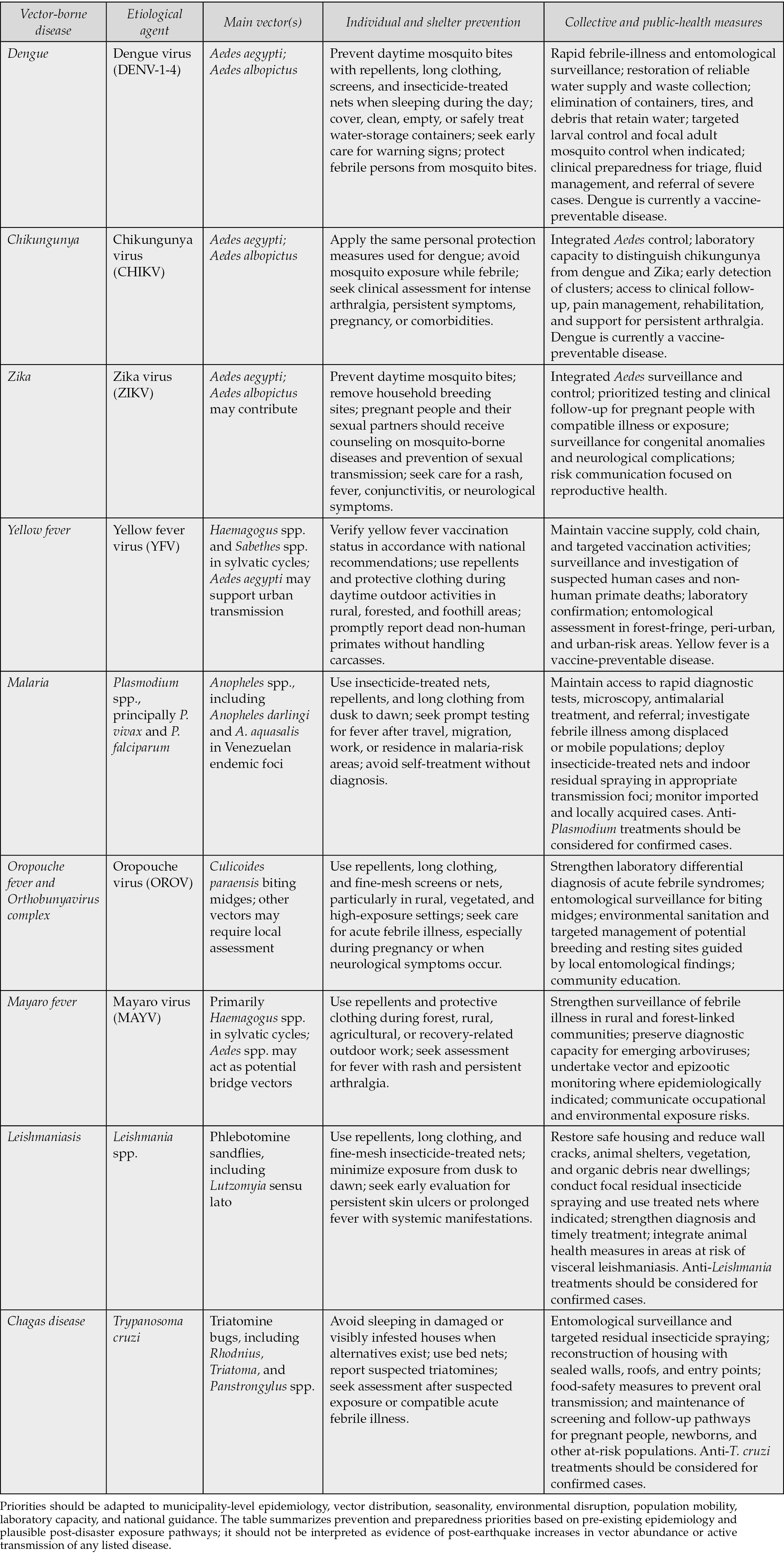
Cutaneous leishmaniasis and Chagas disease are unlikely to cause immediate, large urban outbreaks. Yet they remain medium-term considerations in rural and peri-urban zones. Housing destruction, outdoor sleeping, debris, changes in vegetation and animal shelter, and displacement of domestic and synanthropic animals may alter contact with sandflies and triatomines. Health teams should retain the capacity to recognize persistent ulcerative lesions, prolonged fever with hepatosplenomegaly where relevant, and clinical or epidemiological clues suggestive of acute Chagas disease. These threats reinforce the need to integrate vector surveillance with environmental recovery, housing reconstruction, veterinary services, and community engagement [31]. Table 1 summarizes vector-borne diseases potentially relevant to the post-earthquake setting, their etiological agents and principal vectors, and priority preventive measures at the individual, household, collective, and public health levels.
Table 1 - Priority vector-borne diseases, principal vectors, and prevention measures in earthquake-affected areas of Venezuela.
The response should begin with integrated vector management tailored to each locality. Rapid mapping should identify affected neighborhoods, temporary shelters, water service interruptions, waste accumulation, drainage problems, and sites with historically or currently high Aedes productivity. The photographs in Figure 1 document general temporary-settlement and environmental conditions. They were not accompanied by direct breeding-site inspection or entomological sampling and therefore indicate areas warranting assessment rather than evidence of mosquito proliferation [3, 15, 17].
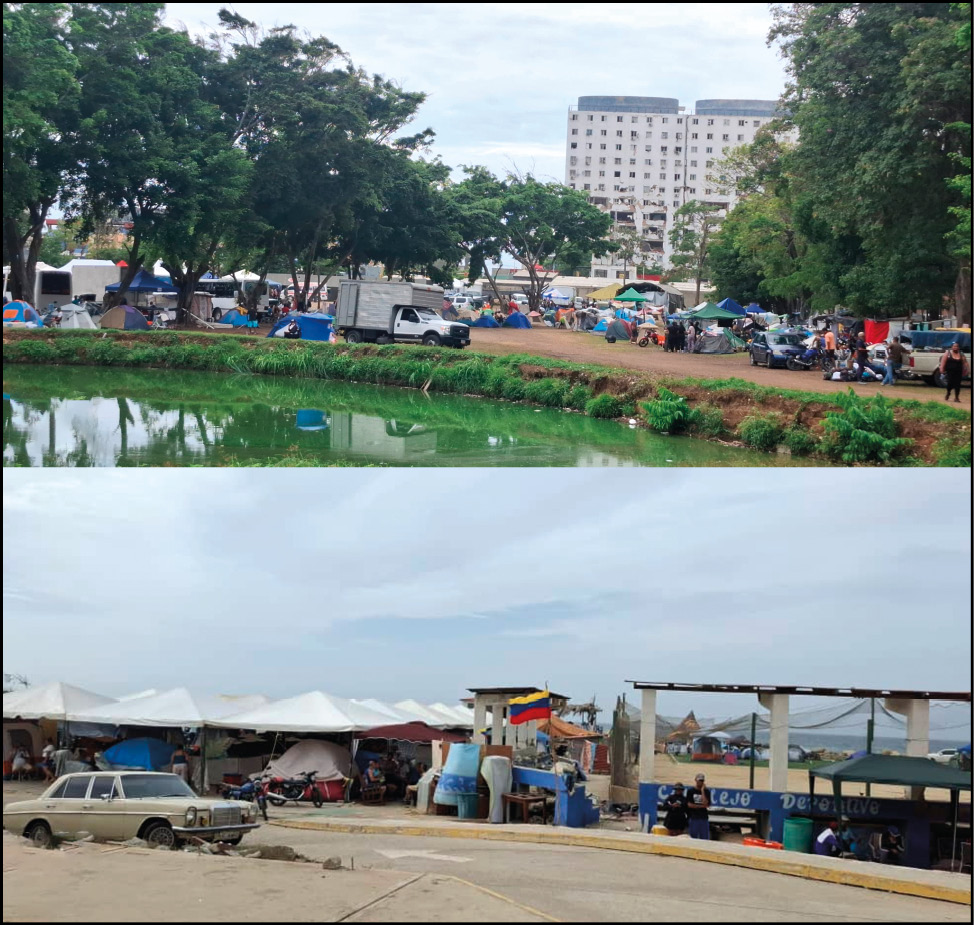
Figure 1 - Temporary settlement environments after Venezuela’s earthquake doublet in La Guaira. A. Caraballeda. B. Playa Verde, Catia La Mar. Both photographs were taken on 7 July 2026 by coauthor Alejandro Risquez and are reproduced with his permission. They were obtained as contextual photographs in public settings without collecting personal information; no identifiable individuals are shown. The images document general environmental and settlement conditions but were not accompanied by larval surveys, entomological sampling, or direct inspection of potential breeding sites. Therefore, they should not be interpreted as evidence of mosquito breeding, increased vector abundance, or post-earthquake transmission of vector-borne diseases.
Surveillance must be active, decentralized, and linked to action. Daily reporting of acute febrile illness, rash, severe arthralgia, neurological symptoms, jaundice, and unusual clusters should be coupled with sentinel entomological monitoring. Data should be disaggregated by locality, shelter, age, pregnancy status, and recent travel. A rise in fever consultations is meaningful only if it triggers investigation, diagnostic sampling, vector assessment, clinical preparedness, and public communication. Laboratories need prioritized capacity for dengue, chikungunya, Zika, malaria, and yellow fever, with specimen-referral networks preserved when local testing is unavailable. Community health workers, shelter coordinators, volunteers, and rescue teams can support source reduction and report heavy mosquito nuisance, visible breeding sites, water accumulation, or animal deaths suggestive of epizootic activity [3, 15, 17, 26, 30].
Risk communication must be practical, credible, and free of blame. Communities should understand that mosquito breeding can increase after service disruption, but that household and neighborhood action remains powerful. Messages should encourage early consultation for fever, abdominal pain, persistent vomiting, bleeding, marked lethargy, jaundice, rash in pregnancy, neurological symptoms, or severe joint pain. They should also explain that repellents, long clothing, window screens, and the elimination of water-holding containers complement rather than replace public services. Engaging schools used as shelters, community leaders, women’s groups, clinicians, and youth volunteers can turn prevention into a shared recovery activity [32].
Venezuela’s earthquake doublet occurred in a setting where health-system fragility, interrupted basic services, and pre-existing vector-borne disease transmission may magnify one another. This does not make epidemics inevitable; it makes early, locally informed action indispensable. Preventing dengue and chikungunya transmission must be a central priority while maintaining surveillance and preparedness for yellow fever, malaria, Zika, leishmaniasis, Chagas disease, and emerging arboviruses. A One Health response that links clinical care, entomological surveillance and control, environmental services, animal health, laboratories, and affected communities can make vector-borne disease prevention an essential component of protecting lives after the rubble is cleared.
Funding
None to declare
Declaration of competing interests
AJRM has been declared a speaker/consultant in the last decade for the following industries involved in dengue and arbovirus vaccines: Sanofi Pasteur, Takeda, Abbott, MSD, Moderna, and Valneva. The remaining authors declare no competing interests.
Acknowledgement
This article has been registered in the Research Proposal Registration of the Coordination of Scientific Integrity and Surveillance of Universidad Cientifica del Sur, Lima, Peru. The authors dedicate this publication to the memory of all those whose lives were lost in the earthquakes, with particular remembrance of the children whose futures were so tragically cut short. We also extend our deepest sympathy to every family in Venezuela and abroad who is now living with the irreplaceable absence of a parent, child, relative, friend, colleague, or member of their community. May this work stand not only as a contribution to prevention and public health but also as a tribute to those affected by this profound tragedy. We honor the lives that were lost and acknowledge the enduring grief carried by their loved ones. In the midst of devastation, we also recognize the remarkable solidarity, courage, compassion, and collective strength shown by families, communities, volunteers, health professionals, and rescuers (both domestic and from countries that have shown solidarity). May the memory of those who have passed remain alive in our hearts and inspire a lasting commitment to care, preparedness, and protection of the most vulnerable. May their legacy remind us that, even in moments of immense sorrow, humanity can respond with dignity, empathy, and hope. We also want to dedicate this Editorial to the still undefined number of physicians and health professionals who died during this catastrophic event.
References
[1] Martín Agudelo L. Venezuela’s double earthquake struck faults scientists had flagged. Science 2026; https://www.science.org/content/article/venezuela-s-double-earthquake-struck-faults-scientists-had-flagged.
[2] Rodriguez-Morales AJ, Rodríguez-Sabogal IA, Sucari A, et al. Reducing Communicable-Disease Risk After Earthquakes: Vaccination and Prevention Lessons for Venezuela’s Doublet. Travel Med Infect Dis. 2026; 73: 103009. doi: 10.1016/j.tmaid.2026.103009
[3] Stewart-Ibarra AM, Hargrave A, Diaz A, et al. Psychological Distress and Zika, Dengue and Chikungunya Symptoms Following the 2016 Earthquake in Bahía de Caráquez, Ecuador. Int J Environ Res Public Health 2017; 14(12): 1516.
[4] Vasquez D, Palacio A, Nuñez J, et al. Impact of the 2016 Ecuador Earthquake on Zika Virus Cases. Am J Public Health. 2017; 107(7): 1137-1142.
[5] Di Bella S, Babich S, Luzzati R, et al. Crimean-Congo haemorrhagic fever (CCHF), present and future therapeutic armamentarium. Infez Med. 2024; 32(4): 421-433.
[6] D’Amore C, Grimaldi P, Ascione T, et al. West Nile Virus diffusion in temperate regions and climate change. A systematic review. Infez Med. 2022; 31(1): 20-30.
[7] Bonilla-Aldana DK, Rodas-Fuenmayor MM, Ruiz-Aristizabal LM, et al. Serological and molecular detection of dengue virus in animals: A systematic review and meta-analysis. Infez Med. 2024; 32(2): 183-201.
[8] Ergönül Ö, Keske Ş, Ksinzik A, et al. The challenges in the monitoring of infectious diseases after the earthquake in Türkiye in 2023. Lancet Infect Dis. 2023; 23(11): e482-e488.
[9] Mavrouli M, Mavroulis S, Lekkas E, Tsakris A. The Impact of Earthquakes on Public Health: A Narrative Review of Infectious Diseases in the Post-Disaster Period Aiming to Disaster Risk Reduction. Microorganisms 2023; 11(2): 419.
[10] Shakya G, Marasini B, Karki KB, et al. Outbreak Investigation Following the 2015 Earthquake Disaster in Nepal. J Nepal Health Res Counc. 2018; 16(1): 61-65.
[11] Tarnas MC, Almhawish N, Karah N, Sullivan R, Abbara A. Communicable diseases in northwest Syria in the context of protracted armed conflict and earthquakes. Lancet Infect Dis. 2023; 23(11): e477-e481.
[12] Kouadio IK, Aljunid S, Kamigaki T, Hammad K, Oshitani H. Infectious diseases following natural disasters: prevention and control measures. Expert Rev Anti Infect Ther. 2012; 10(1): 95-104.
[13] Mehta R, Bhattarai A, Sah R, et al. Pulmonary edema in Dengue: a systematic review and meta-analysis. Infez Med. 2026; 34(1): 28-38.
[14] Regalado-Gutiérrez OA, Carrión-Nessi FS, Ocanto-Ystúriz MA, Ciaccio LMR, Rondón-Pérez AH, Forero-Peña DA. Development and validation of the KAP-arbovirus survey: a new tool for assessing physician preparedness in endemic regions. BMC Health Serv Res. 2026. doi: 10.1186/s12913-026-15078-w
[15] Tejada CE, Aizenberg M, Cucunubá Z, et al. Bridging the Gaps in Dengue Control in Latin America: Multisectoral Strategies from an Expert Panel. Vaccines (Basel). 2026; 14(6): 488.
[16] Rodriguez-Morales AJ, Puerta-Arias MC, Husni R, et al. Infectious diseases prevention and vaccination in migrants in Latin America: The challenges of transit through the treacherous Darien gap, Panama. Travel Med Infect Dis. 2025; 65: 102839.
[17] Rodríguez-Morales AJ, Paniz-Mondolfi AE. Venezuela: far from the path to dengue and chikungunya control. J Clin Virol 2015; 66: 60-61.
[18] Velez Jaramillo Y, Reveiz Montes MA, Galvan-Barrios JP, Picon-Jaimes YA. Maternal and foetal outcomes in women with gestational Dengue: A systematic review. Infez Med. 2025; 33(1): 15-28.
[19] Salazar-Urbano AF, Sussmann-Pena OA, Guezguan-Perez JA, et al. Dengue in patients with kidney transplant: a systematic review. Infez Med. 2025; 33(1): 50-63.
[20] Lizarazo E, Vincenti-Gonzalez M, Grillet ME, et al. Spatial Dynamics of Chikungunya Virus, Venezuela, 2014. Emerg Infect Dis. 2019; 25(4): 672-680.
[21] Srivastava S, Sah R, Babu MR, et al. The emergence of oropouche fever: A potential new threat? New Microbes New Infect. 2025; 65: 101596.
[22] Le NQ, Nguyen HA, Vu KH, et al. High prevalence of dengue with warning signs but absence of severe cases in Vietnamese pediatric patients: an analysis of predictive factors. Infez Med. 2025; 33(4): 404-412.
[23] Rodríguez-Morales AJ, Cardona-Ospina JA, Fernanda Urbano-Garzón S, Sebastian Hurtado-Zapata J. Prevalence of Post-Chikungunya Infection Chronic Inflammatory Arthritis: A Systematic Review and Meta-Analysis. Arthritis Care Res (Hoboken). 2016; 68(12): 1849-1858.
[24] Valero N. Zika virus: Another emerging arbovirus in Venezuela? Invest Clin. 2015; 56(3): 241-242.
[25] Rodríguez-Morales AJ, Ulloa-Gutierrez R, Beltrán-Arroyave C, Risquez A, Hernandez MJ. Why vaccination should be a top priority in relief efforts after Venezuela’s earthquake doublet. IJID Regions 2026; 100954.
[26] Rodriguez-Morales AJ, Navarro JC, Forero-Peña DA, Romero-Alvarez D. Reemergence of yellow fever in Venezuela, 2025/2026. New Microbes New Infect. 2026; 70: 101737.
[27] Srivastava S, Dhoundiyal S, Kumar S, et al. Yellow Fever: Global Impact, Epidemiology, Pathogenesis, and Integrated Prevention Approaches. Infez Med. 2024; 32(4): 434-450.
[28] Srivastava S, Sharma D, Kumar S, et al. Pregnancy Loss, Oropouche Virus and the Lessons from Pernambuco, Brazil. Infez Med. 2024; 32(4): 417-420.
[29] Rodríguez-Morales AJ, Paniz-Mondolfi AE. Venezuela’s failure in malaria control. Lancet. 2014; 384(9944): 663-664.
[30] Rodriguez-Morales AJ, Navarro JC, Paniz-Mondolfi A, et al. Reemergence of Oropouche virus infection in Venezuela, 2025. New Microbes New Infect. 2025; 65: 101583.
[31] Gao Y, Añez N, Chaves LF. High Spatial Resolution Ensemble Species Distribution Modeling of Rhodnius prolixus, Vector of Chagas Disease, in Western Venezuela. Geohealth 2026; 10(5): e2025GH001628.
[32] Guha-Sapir D, van Panhuis WG. Health impact of the 2004 Andaman Nicobar earthquake and tsunami in Indonesia. Prehosp Disaster Med. 2009; 24(6): 493-499.