Le Infezioni in Medicina, n. 3, 269-276, 2023
doi: 10.53854/liim-3103-1
REVIEWS
Update on Mpox: a brief narrative review
Spinello Antinori1,2, Giacomo Casalini1,2, Andrea Giacomelli2, Alfonso J Rodriguez-Morales3,4
1Department of Biomedical and Clinical Sciences, Università degli Studi di Milano, Italy;
2III Division of Infectious Diseases, ASST Fatebenefratelli Sacco, Luigi Sacco Hospital, Milano, Italy;
3Gilbert and Rose-Marie Chagoury School of Medicine, Lebanese American University, Beirut, Lebanon;
4Master of Clinical Epidemiology and Biostatistics, Universidad Cientifica del Sur, Lima 15024, Peru
Article received 7 June 2023, accepted 30 July 2023
Corresponding author
Spinello Antinori
E-mail: spinello.antinori@unimi.it
SummaRY
Mpox (formerly Monkeypox), a neglected tropical disease once confined to Central and West Africa, emerged as a global epidemic outbreak in May, 2022 with 87,529 cases reported as of May, 23, 2023. It predominantly affected men (96.2%) who have sex with men (84-100%), although other transmission routes have been reported, including occupational exposure and vertical transmission. Concomitant HIV infection has been recorded in 21-46.9% and pre-exposure prophylaxis against HIV infection has been reported in 11-57% of published cases. The current outbreak clinical presentation differs from endemic cases with prodromal symptoms that could be absent: the number of lesions is generally low, with skin lesions predominantly localised in the ano-genital areas and frequent lesions present in different stages of progression (i.e., asynchronous). Asymptomatic Mpox infection can occur in 1.8-6.5% of at-risk subjects. People living with HIV with severe immunodeficiency (less than 100 CD4+ lymphocytes per microliter) are at risk of more severe clinical manifestations and death. According to a systematic review and meta-analysis, the hospitalisation rate is around 6% and the observed case-fatality rate is less than 0.1%. Tecovirimat is the drug of choice for treating severe cases although there is no evidence of efficacy from randomised controlled trials. Immunization with a live non-replicating vaccine (JYNNEOS) effectively reduces the disease’s incidence.
Keywords: Mpox, skin lesions, emerging infectious diseases, sexually transmitted infection, tecovirimat.
INTRODUCTION
Human monkeypox (hMpox) infection, once considered a zoonotic disease endemic in West and Central Africa, emerged with a global outbreak in traditionally non-endemic countries in May 2022, raising global public health concern and was declared by World Health Organization (WHO) a Public Health Emergency of International concern (PHEIC) on July 23, 2022. Heterogeneity in the adopted case definition and in the contact tracing indication between WHO and the European Centre for Disease Prevention and Control (ECDC) has been previously noted [1].
As of May 23 2023, a total of 87,529 laboratory-confirmed cases have been reported to WHO from 111 countries across all 6 WHO regions (WHO) [2]. This article provides a useful and updated brief narrative review of the disease.
METHODS
We conducted a comprehensive web-based literature research using PubMed Medline and Scopus in order to identify research studies, case report, case series, meta-analysis dealing with the recent outbreak of Mpox (formerly known as Monkeypox) published between May 1, 2022 and May 31, 2023. We used the terms “Mpox”, “Monkeypox” and the two names associated with “transmission”, “clinical manifestations”, “diagnosis”, “treatment”, “vaccine”, “Jynneos vaccine”, “tecovirimat”, “cidofovir”. The restriction to English language was applied. This is a narrative review and articles were chosen according to their relevance as judged by the two senior authors (SA, AJ R-M).
VIROLOGY
Monkeypox virus is a large (400 nm X 250 nm) double-stranded DNA virus belonging to the Poxviridae subfamily Cordopoxvirinae, with a brick shape. It was initially described in Denmark in 1958 during a smallpox-like outbreak in captive imported macaque monkeys [3]. Although small rodents harbor the virus in Africa, the animal reservoir is still unknown [4]. Mpox virus was originally distinguished into two genetic clades: Clade 1 (or Congo Basin) observed in Cameroon, Congo, the Central African Republic and the Democratic Republic of Congo characterised by a case-fatality rate (CFR) of 11%, and Clade 2 (or West African clade) reported in Ivory Coast, Liberia, Ghana, Nigeria and Sierra Leone with a CFR of 2-3% [5]. The pandemic virus isolated in 2022 was initially considered to belong to Clade 3 but the newly adopted nomenclature by WHO currently recognize the following clades: Clade I (former Clade 1), Clade IIa (former Clade 2) and Clade IIb lineage B.1 (the current circulating hMpox) [6]. In addition, the catalytic enzyme APOBEC3 (Apolipoprotein B Editing Complex), a deaminase that converts cytidine to thymidine and guanosine to adenine, has been postulated to be responsible for the genetic evolution and adaptation to humans and therefore capable of the observed sustained transmission [7].
EPIDEMIOLOGY
The epidemic curve showed a substantial decline from the global peak of 7,576 cases reported on August 8 2022, with a current average of 110 cases observed weekly. Globally, ten countries account for 84.2% of all cases: the United States of America (30,194), Brazil (10,941), Spain (7,551), France (4,146), Colombia (4,090), Mexico (4,017), Perù (3,800), The United Kingdom (3,742), Germany (3,691) and Canada (1,484) [2]. The ongoing outbreak affects mainly male subjects (96.2%) with a median age of 34 years (IQR: 29-41). Men who have sex with men (MSM) are disproportionally affected representing about 84% of all cases for whom this information was available. In the case profile of the WHO, 51.9% were people living with HIV (PLWH) although in different case series the prevalence of PLWH ranged between 35% to 41% [8-11]. The prevalence of HIV infection is less than 5% among women diagnosed with Mpox [12]. Many patients infected with the Mpox virus are on pre-exposure prophylaxis to prevent HIV acquisition (i.e., 11-57%).
Transmission of the Mpox virus can occur through direct contact with the lesion or the fluids contained within during intimate contact between sexual partners [4, 13]; although the virus can be isolated from semen and rectal fluids it is still controversial whether hMpox should be considered a sexually transmitted infection (STI) or not [14-17]. Viral DNA has been detected in skin lesions, oropharynx, saliva, urine, semen, blood and stool of patients infected during the 2022 outbreak [18-20]. Viral loads (VL) were significantly higher from skin lesions and rectal or anal samples (median Ct 19-20) than oropharyngeal, blood, urine and semen samples. Replication competent virus can be isolated in over 70% of samples with VL of 6.5 log10 copies per mL (corresponding approximately to a Ct value of 26) [18-20]. A decrease of VL is observed over time with the longest median time to viral clearance longer for skin lesions (25 days) compared with other body locations (16 days for oropharyngeal and rectal samples, 13 days for semen samples) [18].
A few cases of nosocomial transmission of the Mpox virus to health-care workers have been described as the consequence of needle-stick injury or contact with contaminated surfaces [21]. However, widespread surface contamination has been detected in hospital bedrooms and bathrooms occupied by subjects affected by Mpox including samples from areas deemed to have been not directly touched suggesting possible contamination by droplets [22]. In addition, an outbreak of Mpox in a piercing and tattoo establishment with an attack rate of 37% has been observed in Spain [23]. In the current outbreak cases of Mpox observed in children and adolescents were rarely reported in 0.3% of the USA with exposure in the household setting [24]. Similarly cases described among pregnant women were rare, with 23 cases observed in the USA between May and November 2022 [25]. However, neonatal and breastfeeding transmission has been described in two cases [26, 27].
The Serial interval (SI) (i.e., the time between symptom onset in the primary and secondary case) had a median value of 9.78 days (IQR: 8.9-10.67) in the current outbreak similar to what has been observed for Clade I; however, the incubation period (IP) for Clade IIb was shorter (pooled estimate of 8.26 days) [28].
CLINICAL MANIFESTATIONS
The 2022 Clade IIb outbreak presented unique characteristics that differed from the previous description of the clinical disease [8-11, 29-37]. The prodromal symptoms could be absent: lesions are generally low, with skin lesions predominantly localised in the ano-genital areas and frequently lesions present in different stages of progression (i.e., asynchronous). A skin rash is reported in 90-100% of patients, with localisation in the anogenital area in over 70% of cases (Table 1). The face is involved in 25-39%, the trunk in 21-57%, and palms and soles in 10-28.7% [8-11, 29-35]. The anal or perianal area involving the anorectal mucosa is frequently observed and is responsible for proctitis in 14-36% of cases [8, 10, 11, 29, 30, 32]. Lesions on the lips, tongue and tonsils are reported in 7-14% of cases resulting in difficulty swallowing. Morphology of skin lesions has been reported to be papular (21-31%) [11, 29, 35], vesicular (26-59%) [11, 29, 31, 35], pustular (33-90%) [29, 31, 35]. The number of skin lesions reported was less than 20-25 in 82-88% of subjects, and cases with more than 100 lesions are scarce (1-13%) [8, 31, 36]. Single skin lesion are reported in about 11-12% of subjects with Mpox and, when localised on the genitals, represent a risk of misdiagnosis with syphilis chancres [8, 10, 11, 38]. A purpuric generalised rash has also been observed especially among immunocompromised patients [39]. Fever preceding or concomitant with the skin eruption has been reported in 52-72% of subjects [8-11, 29-32, 34, 35]. Lymphadenopathy especially in the inguinal area is observed in 37-85% of patients [8-11, 29-35].
Table 1 - Epidemiologic and clinical manifestations of Mpox in different studies reporting more than 50 patients
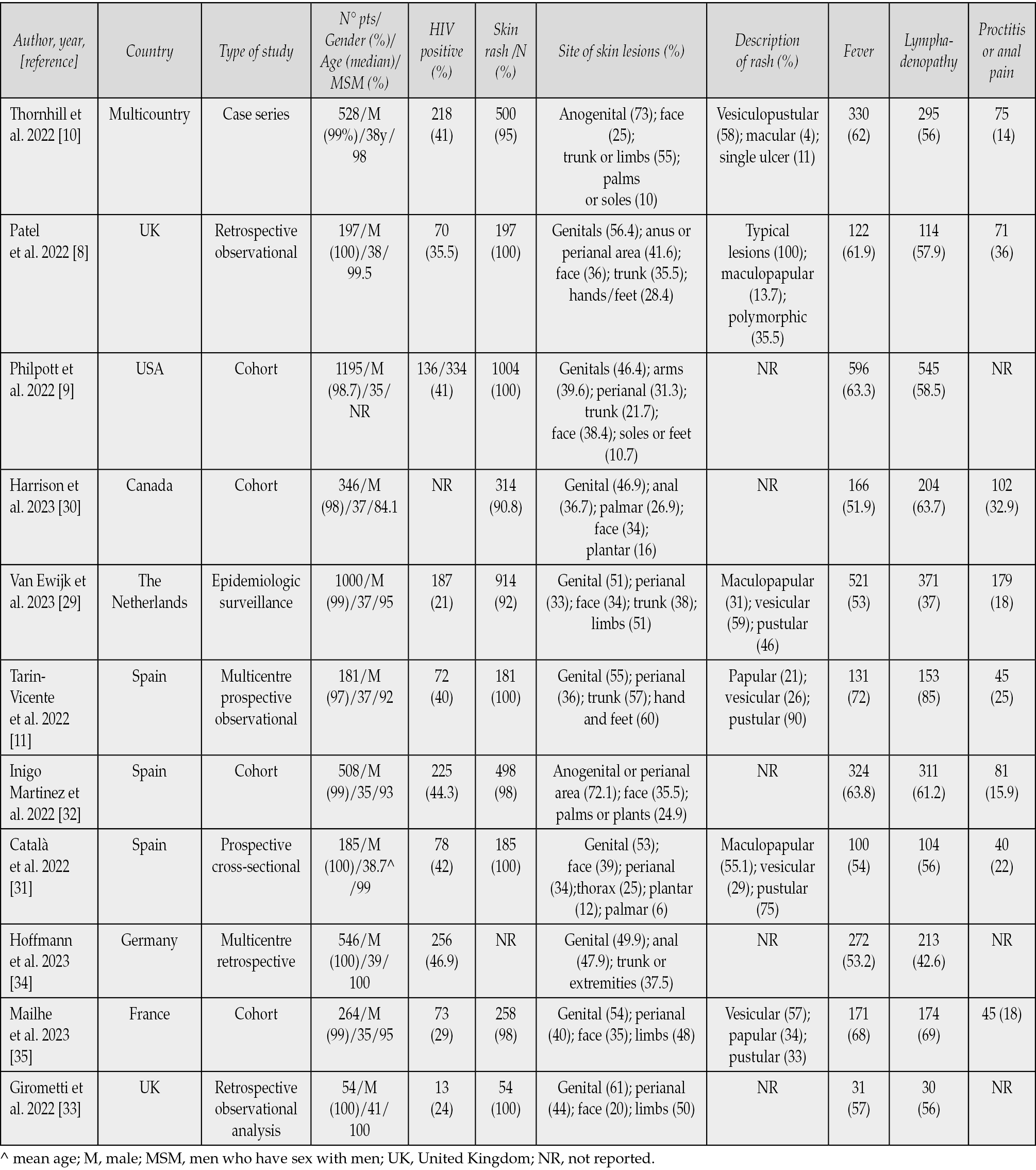
Concurrent sexually transmitted infections have been reported in 17-29% of subjects diagnosed with Mpox in the published cohorts [8-11, 29-35, 40]. Ocular manifestations including conjunctivitis, blepharitis, subconjunctival nodules, keratitis and corneal ulcers are described in 1-21% representing a potentially sight-threatening complication of Mpox [8, 41-43]. Rare but potentially life-threatening complications such as encephalitis, transverse myelitis and myopericarditis have also been reported [41, 42, 44, 45]. In addition, people living with HIV with uncontrolled HIV infection and low CD4+ lymphocytes count, are prone to have severe Mpox infection with necrotising skin lesions (54% vs 7%), lung involvement (29% vs 0), secondary infection or sepsis (44% vs 9%) compared with those with less immunosuppression [46,47]. Finally, an important issue is the existence of asymptomatic subjects with Mpox infection [20]. A recent meta-analysis that also included a study from Cameroon reported a pooled prevalence of asymptomatic Mpox infection of 9.10% (95% CI: 1.27-22.17) [48]; however, the prevalence in studies conducted during the current outbreak was as low as 1.79% (95% CI: 0.70- 4.50) and as high as 6.50% (95% CI: 3.84-10.80) [48].
According to a systematic review and meta-analysis, the hospitalisation rate during the current outbreak was 5.8% [49]. The main reasons for hospital admission are severe proctitis, disease localised to upper respiratory tract affecting swallowing, secondary bacterial infections, ocular or periocular disease, and disseminated cutaneous disease [35,41,42,49,50]. During the 2022 outbreak, the case fatality rate has been less than 0.1% (123/85937) outside Africa [2].
DIAGNOSIS
The diagnosis of Mpox should be suspected in patients with an unexplained rash, especially when lesions are present in the genital (penis, vagina) or anorectal area with or without flu-like symptoms after high-risk exposure [8-11]. Confirmation of case should be obtained by nucleic acid amplification testing (NAAT) by using real-time or conventional polymerase chain reaction (PCR) directed to pan-orthopoxvirus or Mpox-specific [4, 18, 19, 51, 52]. Different targets showing different sensitivities and detection limits have been used and the WHO interim guidance stipulates that diagnostic PCR should include positive controls at low concentration [53]. The most frequently used targets for the Mpox virus included B7R, F3L, G2R, and B6R which could detect 2-20 copies/reaction of DNA virus [52]. A sampling of skin lesions is the best way to achieve a confirmed diagnosis of Mpox infection because RT-PCR can detect a VL of 2 Log magnitude higher than in other samples [18] and the percentage of positivity is higher (88%) in comparison with samples from the throat (77%), anus (71%), blood (29%), urine (225) and semen (54%) [19].
TREATMENT
The clinical management of Mpox infection relies on using antivirals active against the virus, supportive care (especially for pain relief) and antibiotics for bacterial complications [54, 55]. The efficacy of the three potential antivirals available (i.e., tecovirimat, cidofovir and brincidofovir) has not been evaluated in randomized trials. Tecovirimat (Tpoxx) is considered the drug of choice for severe illness (i.e., encephalitis, eye infection, severe proctitis, disseminated skin infection) or for those considered at risk of developing severe disease (immunocompromised subjects, children younger than eight years and pregnant women) [54-57].The drug inhibits the VP37 protein preventing the formation of egress-competent virions. Tecovirimat is available either as an oral or parenteral formulation and it is administered at a dose of 600 mg two or three times (for those with weight > 120 kg) daily for at least 14 days. In the most extensive series reported, 549 patients were treated in the USA under the expanded access investigational new drug protocol [56]. The most frequent underlying medical condition was HIV infection (46.3%) and the median interval from symptoms onset and the receipt of the first tecovirimat dose was seven days. Among 255 patients with available data, the median time of subjective improvement after starting treatment was three days [56]. Adverse events were reported in 3.5% (12/340) of patients including headache, nausea, visual disturbance and one hospitalisation for psychiatric reasons [56]. Cidofovir (not approved for infections caused by Orthopoxviruses) inhibits the incorporation of deoxycytidine triphosphate into viral DNA and therefore terminates the viral DNA elongation [50, 54, 57]. It was used when tecovirimat was not available or in combination with tecovirimat for patients with severe Mpox and as a topical treatment [8, 11, 54, 57]. It is administered intravenously at a dose of 5 mg/kg once weekly for two weeks with coadministration with probenecid. Nephrotoxicity is the main adverse event associated with the use of cidofovir. Brincidofovir is a lipid-conjugated analogue of cidofovir approved by the Food and Drug Administration (FDA) for smallpox treatment. It is administered orally at 200 mg once weekly for two doses. Three patients treated before the 2022 outbreak had increased of liver function tests requiring drug discontinuation [42].
VACCINATION
Two vaccines are recommended for pre-exposure and post-exposure prophylaxis (within four days after a known or presumed exposure). ACAM2000, a replication-competent smallpox vaccine has been licensed in the USA for years to prevent smallpox and was made available for monkeypox infection under an expanded-access investigational new drug protocol. The JYNNEOS (IMVANEX) is a two-dose orthopoxvirus live, a non-replicating vaccine licensed by FDA and the European Medicines Agency (EMA) to prevent smallpox or monkeypox infection [58, 59]. It was initially licensed with a subcutaneous schedule administration. However, due to a shortage in vaccine supply, several countries have authorised intradermal administration (which requires one-fifth of the volume of the subcutaneous route). A study conducted in the USA showed that monkeypox incidence was 9.6 times as high among unvaccinated subjects compared with those who had received two vaccine doses and 7.4 times as high compared with those who had received only the first dose [59]. Another study conducted in Israel using a single subcutaneous dose of the modified vaccinia Ankara (MBV-BN, Bavarian Nordic) showed adjusted vaccine effectiveness of 86% (95% CI: 55-95) [60]. A similar protective result (78% effectiveness against symptomatic Mpox) at least after 14 days following a single-dose was reported in an observational study conducted in the UK [61]. However, breakthrough infections have been observed sometimes with severe manifestations occurring shortly after vaccination [62, 63].
Van Ewijk and coworkers in a cohort of 1000 cases from the Netherlands estimated a protective effect of the first-generation smallpox vaccine against moderate/severe Mpox of 58% (95% CI:17-78%) [29]. Few cases of reinfection during the current outbreak have been reported [64, 65] but in an elegant study Adamo et al. demonstrated long-term maintenance of immunological memory decades after smallpox vaccination as well as a robust T-cell response following Mpox infection (especially after mild disease) [66].
CONCLUSION
Although there is evidence of declining trends of Mpox cases worldwide [67] there is the need to maintain a high index of suspicion about the disease because of the probable persistence of low-level virus circulation with possible occasional outbreaks [4]. In a short period, the scientific community’s response allowed the complete characterisation of the epidemiology, clinical manifestations, diagnosis, treatment and prevention of the current outbreak outside Africa [68]. However, several unanswered questions and knowledge gaps remain about this re-emerging neglected disease representing a global challenge for researchers.
Declaration of competing interest
The authors have no conflicts of interest to disclose concerning this work
Funding sources
This research received no specific grant from funding agencies in the public, commercial, or not-for-profit sectors.
REFERENCES
- Guarducci G, Porchia BR, Lorenzini C, Nante N. Overview of case definitions and contact tracing indications in the 2022 monkeypox outbreak. Infez Med. 2023; 1, 13-19.
- WHO. 2022-23 Mpox (Monkeypox) outbreak: global trends. https://worldhealthorg.shinyapps.io/mpx_global (accessed 29 May 2023).
- Von Magnus P, Andersen EK, Petersen KB et al. A pox-like disease in Cynomolgus monkeys. Acta Pathol Microbiol Scand. 1959; 46, 156-176.
- Farahat RA, Sah R, El-Sakka AA, et al. Human monkeypox disease (MPX). Infez Med. 2022; 3: 372-391.
- Lansiaux E, Jain N, Lavaicuma S, Reinis A. The virology of human monkeypox virus (hMPXV): a brief overview. Virus Research. 2022; 322, 198932.
- Forni D, Cagliani R, Molteni C, Clerici M, Sironi M. Monkeypox virus: the changing facets of a zoonotic pathogen. Infect Genetic Evol. 2022; 105, 105372.
- O’Toole A, Rambaut A. Initial observations about putative APOBEC3 deaminase editing driving short-term evolution of MPXV since 2017. https://virological.org/t/initial-observations-about-putative-apobec3-deaminase-editing-driving-short-term-evolution-of-mpxv-since-2017-830.
- Patel A, Bilinska J, Tam JCH, et al. Clinical features and novel presentations of human monkeypox in a central London centre during the 2022 outbreak: descriptive case series. BMJ. 2022; 378, e072410.
- Philpott D, Hughes CM, Alroy KA et al. Epidemiologic and clinical characteristics of monkeypox cases- United States, May 17-July 22, 2022. MMWR Morb Mortal Wkly Rep. 2022; 71, 1018-1022.
- Thornill JP, Barkati S, Walmsley S, et al. for the SHARE-net Clinical Group. Monkeypox virus infection in humans across 16 countries- April-June 2022. N Engl J Med. 2022; 387, 679-681.
- Tarin- Vicente EJ, Alemany A, Agud-Dios M, et al. Clinical presentation and virological assessment of confirmed human monkeypox virus cases in Spain: a prospective observational cohort study. Lancet. 2022; 400, 661-669.
- Vallejo-Plaza A, Rodriguez-Cabrera F, Sebastain VH, et al. Mpox (formerly monkeypox) in women: epidemiological features and clinical characteristics of mpox cases in Spain, April to November 2022. Euro Surveill. 2022; 27 (48), pii=220867.
- Colavita F, Antinori A, Nicastri E, et al. Monkeypox virus in human body sites and fluids: evidence for transmission. Lancet Infect Dis. 2023; 23, 6-8.
- Allan-Blitz L-T, Gandhi M, Adamson P, Park I, Bolan G, Klausner JD. A position statement on Mpox as a sexually transmitted disease. Clin Infect Dis. 2023; 76, 1508-1512.
- Venkatesan P. Monkeypox transmission- what we know so far. Lancet Respir Med. 2022; 10, e101.
- Golden MR, Wasserheit JN. Monkeypox - A sobering sentinel for pandemic preparedness and sexual health system capacity. N Engl J Med. 2022; 387, 1826-1829.
- Hazra A, Cherabie JN. Is Mpox a sexually transmitted infection? Why narrowing the scope of this disease may be harmful. Clin Infect Dis. 2023; 76, 1504-1507.
- Suner C, Ubals M, Tarin- Vicente EJ, et al. Viral dynamics in patients with monkeypox infection: a prospective cohort study in Sapin. Lancet Infect Dis. 2023; 23 (4), 445-453.
- Palich R, Burrel S, Monsel G, et al. Viral loads in clinical samples of men with monkeypox virus infection: a French case series. Lancet Infect Dis. 2023; 23, 74-80.
- Moschese D, Pozza G, Mileto D, et al. Isolation of viable monkeypoxvirus from anal and urethral swabs, Italy, May to July 2022. Euro Surveill. 2022; 27 (36), 2200675.
- Safir A, Safir M, Hening O, et al. Nosocomial transmission of MPOX virus to health care workers- an emerging occupational hazard: a case report and review of the literature. Am J Infect Control. 2023; 51 (9), 1072-1076.
- Gould S, Atkinson B, Onianwa O et al. Air and surface sampling for monkeypox virus in a UK hospital: an observational study. Lancet Microbe. 2022; 3, e904-e911.
- Del Rio Garcia V, Palacios JG, Morcillo AM, Duran-Pla E, Rodriguez BS, Lorusso N. Monkeypox outbreak in a piercing and tattoo establishment in Spain. Lancet Infect Dis. 2022; 22, 1526-1528.
- Hennessee I, Shelus V, McArdle CE, et al. Epidemiologic and clinical features of children and adolescent aged < 18 years with monkeypox- United States, May 17-September 24, 2022. MMWR Morb Mortal Wkly Rep. 2022; 71 (44), 1407-1411.
- Oakley LP, Hufstetler K, O’Shea J, et al. Mpox cases among cisgender women and pregnant persons- United States, May 11-November 7, 2022. MMWR Morb Mortal Wkly Rep. 2023; 72, 9-14.
- Ramnarayan P, Mitting R, Whittaker E, Marcolin M, O’Regan C, Sinha R, et al. Neonatal monkeypox virus infection. N Engl J Med. 2022; 387, 1618-1620.
- Alonso-Cadena JA, Andina-Martinez D, Garcia-Garcia CJ, Gaitero-Tristan J, Garcia-Ascaso M, Torrelo A. Monkeypox disease in a breastfeeding infant. Pediatr Dermatol. 2023; 40, 214-215.
- Wang S, Zhang F, Yuan Z, et al. Serial intervals and incubation periods of the monkeypox virus clades. J Travel Med. 2022; 29 (8), taac105.
- Van Ewijk CE, Miura F, van Rijckevorsel G, et al. Mpox outbreak in the Netherlands, 2022: public health response, characteristics of the first 1,000 cases and protection of the first-generation smallpox vaccine. Euro Surveill. 2023; 28, pii=2200772.
- Harrison LB, Bergeron G, Cadieux G, et al. Monkeypox in Montreal: epidemiology, phylogenomics, and public health response to a large North American outbreak. Ann Intern Med. 2023; 176, 67-76.
- Català A, Clavo-Escribano P, Riera-Monroig J et al. Monkeypox outbreak in Spain: clinical and epidemiological findings in a prospective cross-sectional study of 185 cases. Br J Dermatol. 2022; 187 (5), 765-772.
- Inigo Martinez J, Montalban EG, Bueno SJ, et al. Monkeypox outbreak predominantly affecting men who have sex with men, Madrid, Spain, 26 April to June 2022; Euro Surveill. 2022; 27, pii=2200471.
- Girometti N, Byrne R, Bracchi M, et al. Demographic and clinical characteristics of confirmed human monkeypox virus cases in individuals attending a sexual health centre in London, UK: an observational analysis. Lancet Infect Dis. 2022; 22, 1321-1328.
- Hoffmann C, Jessen H, Wyen C, et al. Clinical characteristics of monkeypox virus infections among men with and without HIV: a large outbreak cohort in Germany. HIV Med. 2023; 24, 389-397.
- Maihle M, Beaumont A-L, Thy M, et al. Clinical characteristics of ambulatory and hospitalised patients with monkeypox virus infection: an observational cohort study. Clin Microbiol Infect. 2023; 29 (2), 233-239.
- Mileto D, Riva A, Cutrera M, et al. New challenges in human monkeypox outside Africa: a review and case report from Italy. Travel Med Infect Dis. 2022; 49, 102386.
- Wong L, Gonzales-Zamora JA, Beauchamps L, Henry Z, Lichtenberger P. Clinical presentation of Monkeypox among people living with HIV in South Florida: a case series. Infez Med. 2022; 4, 610-618.
- Ciccarese G, Di Biagio A, Drago F, et al. Monkeypox virus infection mimicking primary syphilis. Infez Med. 2023; 1, 113-115.
- Simon-Gozalbo A, Gamo-Guerrero M, Alonso-Garcia S, Mauleon-Fernandez C, Cuevas-Tascon G. Generalized purpuric rash as a clinical presentation of monkeypox infection in a mild immunosuppressed HIV patient: case report. Clin Microbiol Infect. 2023; 29 (1), 122-124.
- Rizzo A, Pozza G, Salari F, et al. Concomitant diagnosis of sexually transmitted infections and human monkeypox in patients attending a sexual health clinic in Milan, Italy. J Med Virol. 2023; 95 (1), e28328.
- Miller MJ, Cash-Goldwasser S, Marx GE, et al. Severe monkeypox in hospitalized patients - United States, August 10- October 10, 2022. MMWR Morb Mortal Wkly Rep. 2022; 71, 1412-1417.
- Fink DL, Callaby H, Luintel A, et al. Clinical features and management of individuals admitted to hospital with monkeypox and associated complications across the UK: a retrospective cohort study. Lancet Infect Dis. 2023; 23 (5), 589-597.
- Carrubba S, Geevarghese A, Salli E, et al. Novel severe oculocutaneous manifestations of human monkeypox virus infection and their historical analogues. Lancet Infect Dis. 2023; 23 (5), e190-e197.
- Cole J, Choudry S, Kular S, et al. Monkeypox encephalitis with transverse myelitis in a female patient. Lancet Infect Dis. 2023; 23 (3), e115-e120.
- Pastula DM, Copeland MJ, Hannan MC, et al. Two cases of monkeypox-associated encephalomyelitis- Colorado and the District of Columbia, July-August 2022. MMWR Morb Mortal Wkly Rep. 2022; 71, 1212-1215.
- Mitjà O, Alemany A, Marks M, et al. Mpox in people with advanced HIV infection: a global case series. Lancet. 2023; 401, 939-949.
- Govind A, Lazarte SM, Kitchell, et al. Severe Mpox infections in people with uncontrolled Human Immunodeficiency Virus (HIV). Clin Infect Dis. 2023; 76 (10), 1843-1846.
- Satapathy P, Mohanty P, Manna S, et al. Potentially asymptomatic infection of monkeypox virus: a systematic review and meta-analysis. Vaccines. 2022; 10 (12), 2083.
- DeWitt ME, Polk C, Williamson J, et al. Global monkeypox case hospitalisation rates: a rapid systematic review and meta-analysis. EClinical Med 2022; 54, 101710.
- Moschese D, Giacomelli A, Beltrami M, et al. Hospitalisation for monkeypox in Milan, Italy. Travel Med Infect Dis. 2022; 49, 102417.
- Huggett JF, French D, O’Sullivan DM, Moran-Gilad J, Zumla A. Monkeypox: another test for PCR. Euro Surveill. 2022; 27 (32), pii=2200497.
- Jiang Z, Sun J, Zhang L, Lai A, Su S. Laboratory diagnostics for monkeypox: an overview of sensitivities from various published tests. Travel Med Infect Dis. 2022; 49, 102425.
- WHO. Laboratory testing for the monkeypox virus. Interim guidance. Geneva WHO 2022.Available from: https://www.who.int/publications/i/item/WHO-MPX-laboratory-2022.1.
- Ivanov DT, Slabakova YA, Argirova RM, Valkov TK. Antivirals for the treatment of Monkeypox: utilization in the general and HIV-positive population and gaps for research. A short narrative review. Infez Med. 2023; 2, 186-194.
- Rao AK, Schrodt CA, Minhaj FS, et al. Interim clinical treatment considerations for severe manifestations of Mpox- United States, February 2023. MMWR Morb Mortal Wkly Rep. 2023; 72, 232-243.
- O’Laughlin K, Tobolowsky FA, Elmor R, et al. Clinical use of tecovirimat (Tpoox) for treatment of Monkeypox under an investigational new drug protocol- United States, May-August 2022. MMWR Morb Mortal Wkly Rep. 2022; 71, 1190-1195.
- Stafford A, Kimmer S, Gilchrist M, et al. Use of cidofovir in a patient with severe mpox and uncontrolled HIV infection. Lancet Infect Dis. 2023; 23 (6), e218-e226.
- Brooks JT, Marks P, Goldstein RH, Walensky RP. Intradermal vaccination for monkeypox- benefits for individual and public health. N Engl J Med. 2022; 387, 1151-1153.
- Payne AB, Ray LC, Cole MM, et al. Reduced risk for Mpox after receipt of 1 or 2 doses of JYNNEOS vaccine compared with risk among unvaccinated persons - 43 U.S. Jurisdictions, July 31-October 1, 2022. MMWR Morb Mortal Wkly Rep. 2022; 71 (49), 1560-1564.
- Sagy YW, Zucker R, Hammerman A, et al. Real-world effectiveness of a single dose of mpox vaccine in males. Nat Med. 2023; 29 (3), 748-752.
- Bertran M, Andrews N, Davison C, et al. Effectiveness of a single dose of MVA-BN smallpox vaccine against mpox in England using the case-coverage method: an observational study. Lancet Infect Dis. 2023; 23 (7), 828-835.
- Berenhs-Riha N, De Block T, Rutgers J, et al. Severe mpox (formerly monkeypox) disease in five patients after recent vaccination with MVA-BN vaccine, Belgium, July to October 2022. Euro Surveill. 2022; 27 (48), pii=2200894.
- Merad Y, Gaymard A, Cotte L, et al. Outcomes of post-exposure vaccination by modified vaccine Ankara to prevent mpox (formerly monkeypox): a retrospective observational study in Lyon, France, June to August 2022. Euro Surveill. 2022; 27 (50), 2200882.
- Musumeci S, Najjar I, Boffi El Amari S, et al. A case of mpox reinfection. Clin Infect Dis. 2023; 77, 135-137.
- Raccagni AR, Canetti D, Mileto D, et al. Two individuals with potential monkeypox virus reinfection. Lancet Infect Dis. 2023; 23 (5), 522-524.
- Adamo S, Gao Y, Sekine T, et al. Memory profiles distinguish cross-reactive and virus-specific T-cell immunity to mpox. Cell Host Microbe. 2023, 31, 928-936: e4.
- Eser-Karlidag G, Chacon-Cruz E, Can Y, et al. Features of Mpox infection: The analysis of the data submitted to the ID-IRI network. New Microbes New Infect. 2023; 53, 101154.
- Rodriguez-Morales AJ, Ortiz-martinez Y, Bonilla-Aldana DK. What has been researched about monkeypox? A bibliometric analysis of an old zoonotic virus causing global concern. New Microbes New Infect. 2022; 47, 100993.