Le Infezioni in Medicina, n. 2 , 284-291, 2021
INFECTIONS IN THE HISTORY OF MEDICINE
Controversies and lessons from the history of smallpox: the case of massive vaccination in British Corfu (1852)
Costas Tsiamis1, Georgia Vrioni2, Chryssa Dimopoulou3, Effie Poulakou-Rebelakou4, Dimitrios Anoyatis-Pele3, Athanassios Tsakris2
1Department of Public and Integrated Health, School of Health Sciences, University of Thessaly, Greece
2Department of Microbiology, Medical School, National and Kapodistrian University of Athens, Greece
3Historical Demography, Faculty of History, Ionian University of Corfu, Greece
4Department of History of Medicine, Medical School, National and Kapodistrian University of Athens, Greece
Corresponding author
Costas Tsiamis
E-mail: ktsiamis@uth.gr
SummaRY
The study presents an anti-vaccination action in the 19th century involving both scientific and political motivation. The research is based on an unpublished archive, namely the registries of the British Executive Police during the massive vaccination campaign in Corfu, the capital of the British possession in the Ionian Islands-Greece (1815-1864), after the smallpox outbreak of 1852. The archival material provides information about the number of vaccinated people, namely their sex, age, nationality, the year of the previous vaccination, along with the last year when a citizen “had smallpox”. The records indicated 40,858 citizens and of these, a total 21,845 (53.46%) were vaccinated. Despite the impressive organization, the vaccination project caused a great controversy at both the scientific and political level between the British authorities and the Greek Ionian Assembly. The archival material gives a diachronic message in the fields of public health, infectious disease control, and health crisis management. The lack of control by a State or local authority, combined with political instability and the public’s ignorance or distrust of scientific matters, are the main factors behind the failure to prevent, restrict or eradicate infectious diseases even nowadays.
Keywords: Ionian Islands, Infectious diseases, Public health, Smallpox, Vaccination.
INTRODUCTION
In the early 19th century, the British authorities introduced the smallpox vaccination in their colonies, with India being the first possession where the British proceeded to the systematic vaccination of a large portion of the population. [1-3] Once Jenner’s method became widely accepted by the medical community, the actual duration of vaccination-induced immunity came into question. The first impression was that the new method conferred lifelong immunity. Nevertheless, over the decades the “epidemiological” data from many European countries accentuated the problem of gradual loss of immunity. In various states where vaccination had been employed for several years (Britain-1799; Bavaria-1807; Denmark–1810; Norway-1811; Bohemia-1812; Russia-1812; Sweden-1816), individuals who had been vaccinated in the past were found to be ill with smallpox [4-6].
The case of British Corfu: the archival sources
The nominal lists of residents of all the villages and neighborhoods of Corfu served as the primary source of information [7]. These lists, in Greek language, are included in the records of the British Executive Police (Polizia Executiva) in the collection of the General State Archives of Corfu. We mention that the use of the mixed Greek, English and Italian terminology in the public documents was a common practice in the Ionian State. The material provided us information on the names, sex and age of the residents of the island, as well as on whether they had been vaccinated or not (Figure 1). As far as the epidemic of 1852 is concerned, the official newspaper of the Radical Party of the Ionian Parliament was used as a source of information, namely the “Φιλαλήθης” (Filalithis), literally meaning “Friend of the Truth” [8]. With regard to the epidemic, we were able to identify the number of infected and deceased individuals. Unfortunately, we didn’t find further data for the outbreak in the official State newspaper “Gazette of the United State of the Ionian Islands” and the Austrian “Observer of Trieste”, a newspaper that is recalled by the “Filalithis”.

Figure 1 - Fragment of the vaccinations’ lists, Executive Police 1852 (General State Archives of Corfu, Greece).
Brief Political History of the Ionian Islands
The Ionian Islands (or The Seven Islands) are located in western Greece: Kerkira (Italian: Corfu), Kithera (Ital. Cerigo), Zakinthos (Ital. Zante), Lefkada (Ital. Santa Maura), Paxos, Cephalonia and Ithaca. Actually, their turbulent history was a result of their strategic geographical position in the Mediterranean Sea. After the 4th Crusade and the first fall of Byzantine Empire, the islands were part of the Republic of Venice until 1797. After the collapse of the Venetian Republic by Napoleon, the Republican French took the control with the promise of full independence. At the turn of the century the islands were a protectorate of the Russian Empire and in 1800, a free Greek State under the name “Septinsular Republic” was created until a new occupation by the Imperial French in 1807. After the final defeat of Napoleon in Waterloo and the Treaty of Paris (1815), the islands gain nominal independence under British Protection [9]. According to the Constitution of the Ionian Islands, a Senate exercised executive power, whereas a regional parliament had taken on legislative responsibilities under the control of the British High Commissioner [10]. The Ionian parliament comprised three parties: the pro-British Conservative Party, the Reform Party (supporters of the independence) and the Radicals (supporters of the union with the Kingdom of Greece) [10, 11]. According to the Protocol of London (1864), the Seven Islands were ceded by Great Britain to Greece as a present to the coronation of Prince William of Denmark as the new King of Greeks, under the name George I [12].
The story of smallpox vaccination in the Ionian Islands
The Venetians originally introduced the old method of variolation in the Ionian Islands in 1798, but the method was met with scientific suspicion and thus failed to spread widely. The republican French adopted the Venetian sanitary model but they totally failed to introduce the vaccinations. Despite the promises for independence, the transformation of the islands into a French colony led to violent reactions and the postponement of the vaccinations.
During the years of the free Septinsular Republic, in 1802, the “Collegio Medico” (Medical College) was founded in Corfu. Among its various responsibilities, the Collegio Medico took care for the implementation of the rules governing vaccination [13]. Unfortunately, Collegio faced the same distrust due to the influence of local healers, physicians and other strong opponents of Jenner’s method, upon the ignorant natives.
During the second French occupation, a vaccination against smallpox under the control of the Commissaires de Police led to new reactions. For the natives, the acceptance of vaccination “under the terror of the bayonet” was equal to the acceptance of French rule. The first reaction, as an act of resistance, was the denial of the vaccination [14, 15].
During the British Protection, a new Vaccination Committee was established in 1815, whose members (Greek physicians and British military physicians) were solely entitled to carry out vaccinations. In villages, parents were required to bring their children to the church of the village on an appointed day for vaccination by the licensed provincial physicians. On the other hand, physicians were not allowed to depart from the village, unless they had made sure that everybody had been vaccinated, whose name was on the lists prepared by the priests and local notables. Physicians’ duties included visiting the children within eight days following their vaccination, in order to evaluate its effects [16]. Finally, in 1845, the Ionian parliament enacted a new strict law entitled «Προνοών περί Δαμαλισμού» (Pronoon peri Damalismou, i.e. “Provision on Vaccination”).
Despite the strict legislation and the help to the British Authorities by the Greek Church, the vaccination program never gains the trust of the natives. In contrary to French, the British refused the “vaccination under arms” and they used a trick in order to promote the procedure. The vaccinations were appointed during the periods of harvest. In case of refusal, the punishment was the isolation in the Lazzaretto (Pest-house). The punishment was of vital interest for the farmers because the isolation would mean the loss of the harvest. As the physician and traveler Hennen reported “in Santa Maura everybody was vaccinated, not because they believed in the effectiveness of the method, but because of the fear of isolation in the terrible Lazaretto” [15, 16].
The smallpox crisis of 1852
In February 1852, a smallpox epidemic was bound to break out in Corfu, coming from mainland Greece. The patients and the deaths were increased on a daily basis until September of the same year, when the outbreak started to decline until its permanent submission in November [8]. Notably, as is evident through the columns of the Filalithis, the first actions of the authorities against smallpox were observed in September 1852, i.e. eight months after the outbreak. According to the data, from February to November 2,123 patients and 365 deaths were reported in Corfu. In 1852, the year when the great epidemic of Corfu occurred, the political situation was particularly tense. The High Commissioner, Lord Frederick Ward, tried to abolish the law “On Freedom of Press”. Also, he tried to introduce a decree based on which he would be entitled to impose martial law. The Ionian elections of 1852 took place in the midst of the political violence and the epidemic. Finally, Lord Ward ceased the operation of the new elected parliament for an indefinite period.
The records of the vaccination
The situation during the epidemic in the capital of the British possession was explosive. The announcement of the first dead British soldier, eight months after the first victim of the outbreak, led to more tension between the natives and the Authorities. The deputies accused the British that they preferred to protect only the army and the navy and they left the citizens to their fate. Also, according to the public accusations, the British had violated the quarantine procedures and that it was another evidence of their disinterest for the public health.
The British authorities decided to massively vaccinate the population of Corfu in December 1852 and - in some villages - in January and February 1853. The whole operation was captured in the records of the British Executive Police. It is very interesting the fact that, according to the medical instructions, the patients with malaria and syphilis were excluded from the vaccination. The lists had important comments and notes about the patients, such as “he/she is now very dangerous” or “he/she is isolated at home by guard” etc. In the context of the study, findings were grouped alongside the five regions of the island, as designated by the British authorities for administrative purposes. The percentages of the final findings were calculated based on the total number of citizens who were registered in the records.
Unfortunately, the previous census conducted by the British authorities dated from 1824, which not only was chronologically distant from 1852 but also failed to bring out any demographic fluctuations throughout that 28-year period. In essence, the records of 1852 constitute a peculiar census at the same time. The overall number of citizens who were found in the records totaled 40,858 individuals. Of these, a total 21,845 were eventually vaccinated (53.46% of the entire population). Our reading of the records shows that, among all those vaccinated, the male population (55.8%) prevailed over the female (44.2%). As far as the age of vaccinated inhabitants is concerned, in their majority they fell within the age groups 1-10 and 11-20 years, each with 5,240 and 5,332 individuals respectively (Figure 2). The number of those vaccinated aged 40 and above is consistently lower than the number of those who were not vaccinated. Of particular interest is the comprehensive mapping of the overall healthcare operation which, once again, seems to have been avoided by a significant proportion of the population, since many chose not to vaccinate despite the British orders.
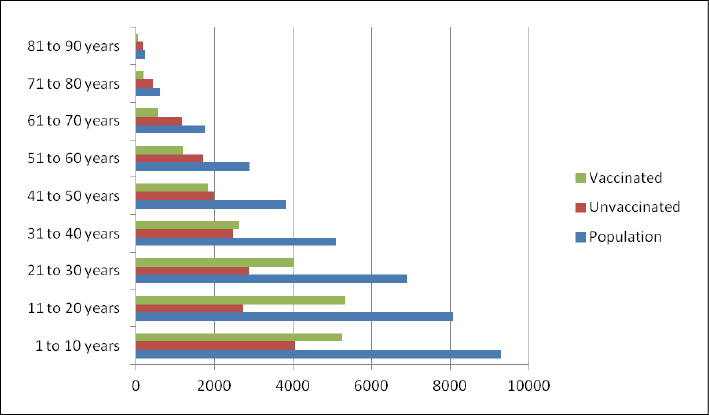
Figure 2 - Number of vaccinated and unvaccinated individuals per age group.
With regard to the city of Corfu, the lists provide a number of 6,294 citizens (4,836 natives and 1,458 foreigners). A total of 4,610 citizens were vaccinated, the vast majority of whom were natives. Among the foreigners of Corfu (either Greeks from other areas or foreign nationals), only a small number were actually vaccinated. The lists of vaccinated foreigners mention persons from England, Ireland, Malta and Italy. It is noteworthy that the largest number of vaccinated individuals designated as “foreigners” were the members of the Jewish community of the city (121 persons). As “foreigners” were also listed 98 Greeks from mainland Greece, 77 coming from the rest of the Ionian Islands and one person from Cyprus. Unlike rural areas, the urban age group of 1-10-year-old had the highest percentage of vaccination. It is also worth mentioning that the group covering the ages between 21-30 years had similarly high shares.
Special groups of vaccinated and unvaccinated citizens
Based on the study and the analysis of the data obtained from the details of the nominal lists, three significant elements arise in relation to:
a) whether an individual was vaccinated;
b) whether the individual had become ill with smallpox in the past;
c) whether the individual became ill with smallpox during the last epidemic of 1852.
Through the combination of these three elements, and given that each of them has either a negative or a positive answer, we may determine specific sub-categories that lead us to interesting conclusions. As already noted, a total 21,845 citizens were vaccinated, although the nominal lists provide data on their history of smallpox for 17,141 of them only. As for the unvaccinated individuals, the lists provide details on their history of smallpox for 11,322 persons. On the basis of the above data, the following categories and combinations were determined for 28,437 persons, i.e. 70% of the total recorded population (Table 1).
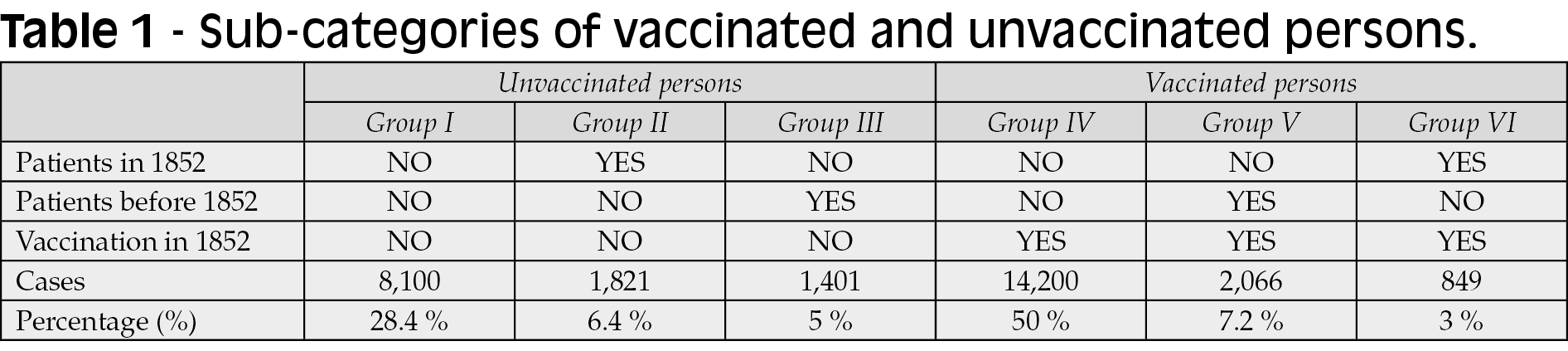
Of course, another two combinations may be identified:
a) citizens who were not vaccinated in 1852 and became ill both in the past and in 1852;
b) citizens who were vaccinated in 1852 and became ill in the distant past as well as in the recent epidemic.
As far as these combinations are concerned, available data were insufficient for a safe conclusion to be drawn and, therefore, they were not considered in our study. It should be noted, however, that no exact dates were recorded for particular individuals who had become ill in the past; instead, their records included vague indications like, “became ill when he was child”, “became ill when he/she was young” or “became ill but he/she cannot remember the year”. The examination of the groups reveals that the category with the highest percentage (50%) includes those who were vaccinated and had not become ill in the past, nor in the epidemic of 1852. The category with the second largest percentage (28.4%) includes those citizens who were never vaccinated and never became ill with smallpox. Then, with a percentage rate of 7.2% are citizens who were vaccinated, and became ill in the past but did not get infected in the epidemic of 1852.
Evidence of past vaccinations was recorded in a separate column, next to the names of the citizens. These data allowed us to investigate the stringency of laws governing vaccinations and, most importantly, compliance with the strict law of 1845. Presumably, the accuracy and rigor of laws and decrees guaranteed proper as well as obligatory vaccination. However, from 1815 until 1851, a mere 6,442 citizens were recorded, whereas considering those individuals who were variolated/vaccinated in the period 1798-1814, the total number of vaccinated citizens rises to a mere 7,069. It is also striking that even after the enactment of the stringent law on vaccination in 1845, and until the year of the epidemic, only 934 people had been vaccinated (Figure 3).
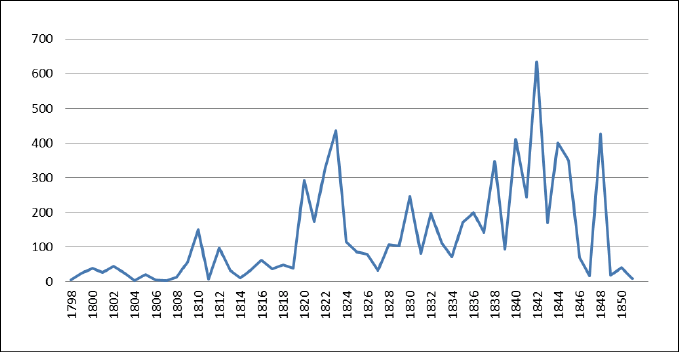
Figure 3 - Number of vaccinated persons per historic periods in Corfu: 1797-1800 Republican French, 1800 Russian Portectorate, 1800-1807 Septinsular Republic, 1807-1814 Imperial French, 1815-1864 British Protection.
Discussion
During 19th century, the legislation on vaccination across Europe or transatlantic colonies, had the children and the young population as primary target groups [17]. Respectively in our case the authorities’ priorities were age-groups 1-10 and 11-20. The examination of individual groups reveals that half of vaccinated individuals belong to the category of those who were vaccinated without having become ill in the past, including the epidemic of 1852.
The temporal distance between the past illness and the vaccination of 1852 varies in average of 20.5 years. Two extreme cases of citizens who were vaccinated in 1852 are exemplary: the first involved an individual who “had smallpox” the previous year (1851), whereas the second refers to someone who was ill in 1798, i.e. 54 years ago. As for the temporal distance between a past vaccination and the re-vaccination of 1852, the average was 21.5 years. The issues of the first vaccination and the time frame of the re-vaccination were under debate inside the medical communities. It is interesting to note a coincidence between our case and the evolution of British legislation on vaccinations. Few months after the outbreak, the first compulsory vaccination Act for England and Wales was passed in the House of Lords. On April 2nd, 1853, Lord Lyttleton presented in his introduction of Vaccination Extension Bill the data of the “Report on the State of smallpox in England and Wales and other countries and on Compulsory Vaccination” by the Epidemiological Society of London. The report was a summary of vaccination laws in various countries, mortality data, and proofs of the consequences of the vaccination neglect in England and Wales. The suggestions of the epidemiological report were the compulsory character of the vaccination three or four months after the birth and the registration of the births as the foundation of the machinery for every vaccination [18].
It’s noteworthy that during 1850s in Great Britain was appeared a social movement against the power of the State that led to restriction of the human liberty. In this frame, during the smallpox epidemics of 1870s anti-vaccination associations were formed across the country. At the end of the 19th century over half of the children in east London districts remained unvaccinated. Moreover, the pressure of the anti-vaccination associations led the British government to modify the compulsory character of the vaccination [18].
The British Protection established the principles of preventive medicine in this part of Greece for the first time. A key finding lies in the fact that the health system of the period had established a legal framework for carrying out vaccinations. Nevertheless, the data indicate an ineffectiveness of implementation despite the existence of strict legislation. It is also important that following 1845, i.e. when the new law on vaccination was adopted, very few people were vaccinated. One month after the start of the epidemic, the closure of the Parliament affected the election and the placement of new directors and sanitary officers in key positions of all health institutions (vaccination committee, sanitary committees, committees for restriction of venereal diseases, pest-houses, hospitals etc). Both sides lost their composure and the instinctive reactions of the islanders were dictated by wrath to the High Commissioner and ignorance to the medical suggestions. It appears that the controversy between the High Commissioner and the Senate had adverse effect on the operation of the State and, to some extent, may explain the failure of the authorities in curbing the epidemic, as well as the hesitance of citizens to vaccinate as a social reaction.
Meanwhile, the rumors by the opponents of Jenner’s method and the members of the anti-British political coalition, that the victims of the outbreak were vaccinated against smallpox, led to a stormy crowd reaction against the medical services. According to the public opinion, if the victims were previously vaccinated this was “a strong evidence of Jenner’s method ineffectiveness” or, in worst case, the storage of the vaccines at the Magistrate of Health was insufficient and dangerous. It is very interesting, but also indicative of the crowd psychology, the fact that the natives, the physicians and the deputies used the “ineffectiveness” of Jenner’s method as a political tool for their fight for independence. The case of Corfu has similar elements with other social reactions on political motivation. In Montreal, in 1885, the French-Canadian population refused the vaccination of their children as a reaction to the Anglo-Canadian rule [19].
The history of the British Protection in Ionian Islands was characterized by calm political periods. Also, Corfu was an important Mediterranean trade center and naval base of the British Navy. Most of the High Commissioners were popular, and due to their inspired decisions, the peaceful periods of the Greek-British co-existence were based on the feeling of political, religious and trade freedom. But, during the periods of political tension, the first instinctive reaction of the inhabitants was the violation of the sanitary legislation (i.e. marine quarantine, vaccination etc.) on political motive, despite the dangers for the public health.
The combination of epidemics and political disturbances is a timeless phenomenon in the human history. Nowadays, the management of dangerous outbreaks, especially in low income countries with serious infrastructure problems, contains a multilevel approach [20]. In cases of multinational health operations, the responders are obliged to take into consideration the different socio-political, cultural, economic and religious elements of the local population [21-23]. The knowledge of the cultural characteristics and the understandable information of the population by the authorities are of vital importance in order to prevent any sanitary action from misconceptions.
CONCLUSIONS
Our historical case highlights the timeless risk of political instability in an area during a serious health crisis and how this affects the outcome of a health operation or the projects of the humanitarian aid. The lack of centralized control by the competent authorities, combined with the refusal of citizens to comply with the medical suggestions as a token of their reactions, are both factors of failure of a health campaign even nowadays. As for the anti-vaccination movement, it is an old issue in the history of Public Health. Nevertheless, in our days, this problem appears to be the new challenge for the health authorities worldwide. Before two years was the starting point point of World Health Organization’s new 5-year strategic plan against threats of global health. According to WHO the vaccination hesitancy, in any motivation, is one of the 10 most important issues that will demand special attention from the health authorities. (www.who.int/emergencies/ten-threats- to-global-health-in-2019)
REFERENCES
[1] Fischer-Tiné H, Michael Mann M. Colonialism as civilizing mission: Cultural ideology in British India. Anthem Press, London, 2004.
[2] Bhattacharya S, Harrison M, Worboys M. Fractured States: Smallpox, Public Health and vaccination Policy in British India 1800-1947. Orient Longman, New Delhi, 2005.
[3] Keller R. Geographies of power, legacies of mistrust: Colonial Medicine and the Global present. Hist Geogr. 2006; 34, 26-48.
[4] Fenner F, Henderson D, Arita I, Jezˆek Z, Ladnyi I. Smallpox and its eradication. History of International Public Health, Series No 6. World Health Organization, Geneva, 1988.
[5] Davenport R, Schwartz L, Boulton J. The decline of smallpox in eighteenth century London. Econ Hist Rev. 2011; 64 (4), 1289-314.
[6] Eyre G. General Board of Health. Papers relating the history and practice of vaccination. Spottiswoode, London, 1857.
[7.] Polizia Executiva 1852-53, F.643. General State Archives of Corfu. (Greek text)
[8] Newspaper “Filalithis”. Fol. 26th July, 22th August, 13th September, 30th September, 15th October, 23th October, 31st October, 8th December,16th December 1852. (Greek text)
[9] Gallant T. Experiencing Dominion: Culture, Identity and Power in the British Mediterranean. University of Notre Dame Press, Indiana, 2002.
[10] Kirkwall V. Four years in the Ionian Islands: their political and social condition with a history of the British Protectorate. Chapman & Hall, London, 1864.
[11] Knox B. British policy and the Ionian Islands 1847-1864: Nationalism and Imperial Administration. Engl Hist Rev. 1984; 94, 503-29.
[12] Xenos S. East and West: a diplomatic history of the Annexation of the Ionian Islands to the Kingdom of Greece. Trubner, London, 1865.
[13] Tsiamis C, Thalassinou E, Poulakou-Rebelakou E, Anoyatis-Pelé D, Hatzakis A. Infectious diseases control in the Ionian Islands during the British Protection (1815-1864). J R Army Med Corps. 2013; 159 (3), 247-54.
[14] Administration du Commisaire Impérial Jul. Bessières. Ameliorations faitesou à faire dans les différentes branches de l’administration, 2ème Partie 28 Août 1809”. Archives du Ministère de la Guerre, Armée de Terre, MR 79/1628, “Grèce et Iles Ioniennes”.
[15] Tsiamis C, Thalassinou E, Poulakou-Rebelakou E, Hatzakis A. Quarantines and British “Protection” of the Ionian Islands (1815-1864). In Quarantines: Space, Identity and Power in Mediterranean, 1780-1914, eds. John Chircop, John, and Francisco, Martinez, 256-279. Manchester University Press, Manchester, 2018.
[16] Hennen J. Sketches of the Medical Topography of the Mediterranean comprissing an account of Gibraltar, the Ionian Islands, and Malta to which is prefixed, a sketch of a Plan for Memoirs on Medical Topography. Vol. II. Thomas & George Underwood, London, 1830.
[17] Hopkins D. The greatest killer: Smallpox in History. The University of Chicago Press, Chicago, 1983.
[18] Rolleston J. The smallpox pandemic of 1870-1874. Proc R Soc Med. 1933; 27 (2), 177-92.
[19] Hays J. Epidemics and Pandemics: their impacts on human history. ABC Clio, California, 2005.
[20] Guillaume Y, Ternier R, Vissieres K, Casseus A, Chery M, et al. Responding to cholera in Haiti: implications for the National Plan to Eliminate Cholera by 2022. J Infect Dis. 2018; 218 (Supl.3), S167-70.
[21] Ivers L, Guillaume Y. The Price of Peace? Peacekeeping with impunity harms public health in Haiti. Am J Trop Med Hyg. 2017; 97 (3), 639-40.
[22] The Lancet Global Health. The UN in Haiti: an adulterated vision accountability. Lancet Glob Health. 2016; 4 (12), e872.
[23] Nuriddin A, Jalloh M, Meyer E, Bunnell R, Bio F, et al. Trust, fear, stigma and disruptions: community perceptions and experiences during periods of low but ongoing transmission of Ebola virus disease in Sierra Leone, 2015. BMJ Glob Health. 2018; 3 (2), e000410.